

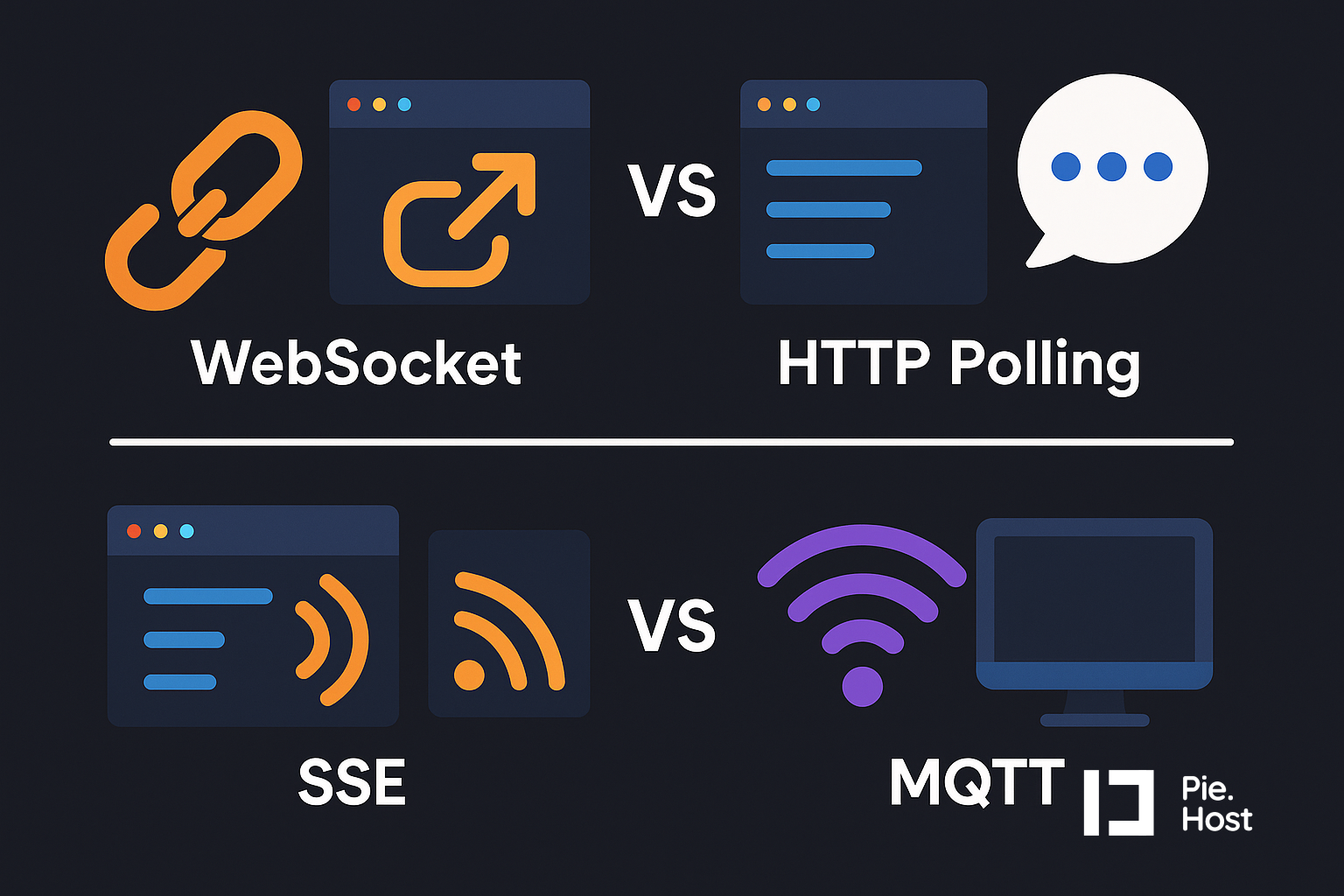
WebSocket vs HTTP Polling vs SSE vs MQTT — Deep Comparison
Lets look into WebSocket vs HTTP Polling vs SSE vs MQTT
Rabikant
Mar 9, 2026
Over the past decade, the way applications communicate has undergone a dramatic transformation. The old model—where browsers loaded full pages and waited for the next click—has been replaced by fluid, always-connected experiences. Modern users expect messages to appear instantly, multiplayer game states to sync in milliseconds, stock charts to update tick by tick, and collaborative documents to reflect edits the moment they occur. IoT devices add millions of tiny data streams on top of that. This shift has demanded faster, more persistent, and more efficient ways for devices and servers to exchange data in real time.
To meet these expectations, real-time communication has evolved far beyond the traditional request–response cycle of classic HTTP. Today, four primary technologies dominate how apps handle live data: HTTP Polling, Server-Sent Events (SSE), WebSocket, and MQTT. Each grew out of different constraints, solves different problems, and behaves uniquely under heavy traffic. Understanding their strengths and limits is key to building fast, cost-efficient systems.
HTTP Polling was the earliest attempt to mimic real-time updates. The idea is simple: the client repeatedly asks, “Anything new?” This works everywhere and is easy to implement, but it wastes bandwidth because most requests return no new data. When user counts or message frequency grows, polling puts unnecessary pressure on servers. It’s reliable for occasional data checks but falls short when an application needs rapid or continuous updates.
SSE (Server-Sent Events) improved this approach by letting the server push updates whenever something changes. With one long-lived connection, clients receive a steady stream of messages without repeated requests. This makes SSE efficient for live dashboards, notifications, or activity feeds. It reconnects automatically and uses standard HTTP, but it’s still one-directional—great for updates coming from the server, not ideal for interactive apps requiring clients to send data back frequently.
WebSocket took real-time communication a step further by enabling full-duplex messaging. Once connected, both the client and server can send data at any time over a single persistent channel. This is crucial for modern interactive systems like chat apps, multiplayer games, collaborative editors, and financial trading tools. WebSockets provide extremely low latency and handle bursts of rapid communication with minimal overhead. However, they require more complex infrastructure, including load balancers and stateful scaling strategies.
MQTT, meanwhile, emerged from the world of IoT. Designed for low-power sensors and unstable networks, MQTT uses a lightweight publish–subscribe model managed by a broker. Devices publish data to “topics,” and subscribers instantly receive updates. Its reliability settings (QoS levels) and tiny bandwidth footprint make it ideal for smart homes, vehicle telemetry, industrial devices, and large-scale sensor networks. MQTT is not native to browsers, but it excels where efficiency and connection stability matter more than rich interactivity.
Choosing between these technologies isn’t just a technical preference—it directly affects performance, user experience, and cost. Picking the right protocol can reduce server load, shorten delays, and make your app feel smoother even under massive traffic.
How Web Communication Evolved: From Static Pages to Real-Time Streams
When the web began, pages were stuck - no updates once loaded. Hitting a link made your browser fire off an HTTP request. The server replied with new HTML right away. After that, things froze completely. No moving parts. Tough enough to handle the job. Fits perfectly based on how folks first used the web. Even so, as apps improved, user needs shifted - because fresh features arrived, expectations moved just as quick Chat apps relied on fast messages. Trading apps needed live price updates. Online play needs matching game conditions. Writers on the team needed instant tips, so they could share updates quickly. Back in the day, HTTP only sent data when asked - meaning it struggled with today’s demands. Dev folks began devising smart hacks - sorta workarounds - to fake quick replies
Short Polling — send repeated HTTP requests at fixed intervals
Long Polling — keep a request open until the server has new data
SSE — server pushes events to the client over one long connection
WebSockets — true full-duplex, low-latency, bidirectional connection
These innovations fundamentally changed how modern applications operate. The next sections break down each technology.
HTTP: The Foundational Request–Response Protocol
HTTP (Hypertext Transfer Protocol) remains the backbone of the internet. Whether you're visiting a website, submitting a form, fetching data from an API, or downloading a file — you're likely using HTTP.
How HTTP Works
HTTP uses a simple model:
- The client sends a request.
- The server processes it and sends a response.
- The connection closes.
It’s stateless, meaning the server doesn’t inherently remember previous interactions unless external storage (sessions, cookies, tokens) is used.
Why HTTP Dominates the Web
- Universal compatibility across all devices and browsers
- Simple debugging and easy testing
- Powerful caching to reduce repeated server loads
- Strong security via HTTPS
- Scalable design since each request stands alone
Evolution of HTTP
Over time, HTTP has improved:
HTTP/1.1
- Persistent connections
- Pipelining (limited in practice)
- Widely adopted
HTTP/2
- Multiplexing (multiple requests over one connection)
- Header compression
- Better performance for modern apps
HTTP/3
- Built on QUIC (UDP)
- Faster, more reliable, optimized for mobile
Despite its evolution, HTTP fundamentally remains request-based. It’s perfect for loading pages or requesting new data — but not ideal for scenarios where the server needs to push real-time updates.
WebSocket: Real-Time, Full-Duplex Communication
WebSocket was designed to solve the biggest limitation of HTTP: its inability to maintain a persistent, two-way channel.
What Makes WebSocket Special?
WebSockets offer:
- Persistent connection
- Client ↔ Server bidirectional communication
- Low latency
- Reduced overhead compared to HTTP
- Support for both text and binary data
Once connected, both sides can send messages anytime — no polling required.
How the WebSocket Handshake Works
The connection begins with an HTTP request using the Upgrade header:
GET /ws HTTP/1.1
Host: example.com
Connection: Upgrade
Upgrade: websocket
The server replies:
HTTP/1.1 101 Switching Protocols
Upgrade: websocket
Connection: Upgrade
At this moment, the connection switches from HTTP to WebSocket. The pipe stays open until one side closes it.
Why Developers Choose WebSockets
When the web started, pages just sat there - no changes after loading. Clicking a link sent your browser scrambling to fetch data through an HTTP call. In return, the server shot back fresh HTML on the spot. From then on, everything locked up tight. Nothing shifted at all. Tough enough to get things done. Just right when you think about how people started using the web. Still, when apps got better, what people wanted changed - since new tools showed up, hopes raced ahead too Chat apps used quick texts. Trading apps required real-time price changes. Playing online works best when settings are alike. Writers in the group wanted fast advice, that way they’d post news without delay. Earlier on, HTTP delivered info just when prompted - so it couldn't keep up with what we need now. Dev people started coming up with clever tricks - kinda like shortcuts - to mimic fast responses
Why Use PieSocket
When you decide WebSockets are the tool the next question is do you build your own WebSocket server infrastructure or use a managed solution and, this is where PieSocket comes in.
So, here's what makes PieSocket compelling:
It provides a managed WebSocket/Pub Sub server API. You won’t have to build, scale, or maintain your own socket infrastructure. It supports presence, channels, in addition to event publishing and, subscribing. These features are useful for chat, live updates, and collaboration. The design allows for scaling. You can start small and let the service handle growth, spikes, and, infrastructure concerns. It frees you to focus on your app logic. You won’t have to worry about socket server ops.
Link: Piehost.com
HTTP vs WebSocket: A Deep Technical

HTTP and WebSocket are two of the most widely used communication protocols on the modern web, but they solve fundamentally different problems. Understanding how they differ at the technical level helps developers choose the right tool for their application—especially when building systems that require real-time, low-latency, or event-driven communication.
Communication Model
At the heart of the difference is how messages flow between client and server.
- HTTP is strictly request–response, meaning the client must always initiate communication. The server cannot send data unless asked for it.
- WebSocket is full-duplex, which means both the client and server can send messages independently at any time.
This makes WebSocket far more suitable for applications that demand live updates or bi-directional messaging.
Connection Behavior
HTTP — Short-Lived Connections
Each interaction opens a new connection (unless using keep-alive on HTTP/1.1 or multiplexing via HTTP/2), delivers a response, and then closes. This is efficient for traditional website interactions but introduces overhead in real-time systems.
WebSocket — Persistent, Always Open
A WebSocket connection stays open once established. No repeated handshakes or request cycles are required. This persistent connection dramatically cuts overhead and enables instantaneous message delivery.
Latency Comparison
- HTTP latency is higher due to repeated handshakes, full headers, and the request-driven approach.
- WebSocket latency is extremely low because the connection is always active and messages are sent as lightweight frames.
For applications requiring millisecond-level responsiveness—like gaming or stock trading—WebSockets are far superior.
Bandwidth Efficiency
HTTP sends full headers with each request, often hundreds of bytes even when the payload is tiny. This makes frequent updates wasteful.
WebSocket frames, on the other hand, are compact and binary-friendly, making them ideal for high-frequency communication with minimal overhead.
Scalability Differences
HTTP Scaling Is Easier
Since HTTP is stateless, scaling horizontally with load balancers is straightforward. Any server can handle any request.
WebSocket Scaling Is More Complex
Persistent connections require:
- Sticky sessions
- Connection-aware load balancers
- Message brokers (e.g., Redis Pub/Sub, Kafka) for distributed systems
5This complexity doesn’t make WebSocket “bad”—it simply means it requires more planning for large-scale systems.
Real-Time Capability
- HTTP: Limited real-time capabilities unless combined with techniques like polling or SSE.
- WebSocket: Purpose-built for real-time, event-driven communication.
When instant updates matter, WebSocket is the clear choice.
Caching & Storage
HTTP benefits from browser caching, CDN support, and strong caching headers. WebSockets do not natively support caching because data is dynamic and streaming-based.
Real-World Use Cases: When to Choose HTTP vs WebSocket
Use HTTP For
- Loading webpages
- RESTful API calls
- File uploads or downloads
- CRUD operations
- Form submissions
- Delivering static assets (CSS, JS, images)
HTTP is perfect for traditional client–server interactions where the user triggers each request.
Use WebSocket For
- Chat and messaging applications
- Multiplayer gaming
- Real-time dashboards
- Live financial/market data streams
- Collaborative editing tools
- Instant notifications
- IoT device monitoring and control
If data must flow continuously or events need to be pushed instantly from server to client, WebSocket is the ideal solution.
The Rise of Real-Time: Why Polling and SSE Exist
The way web apps work has changed fast - starting from basic pages to live, responsive systems - and this shift deeply affected how browsers talk to servers. Instead of WebSockets right away, coders once relied on clever hacks using regular HTTP just to fake quick updates. During that phase, two key approaches stood out: hitting the server repeatedly and one-way event streams. These days, even by 2025, people still use them - not because they’re old-school, but 'cause they fit certain needs well. To grasp why polling or SSE stay relevant now, let’s check how live-data needs started - also what gaps remain even with WebSockets around.
Why Polling and SSE Were Needed in the First Place
Before WebSocket technology matured, browsers had no native way to keep long lived, interactive communication channels open, HTTP was designed for one way, request driven communication, the client asks, the server responds. This model worked well for early web pages. It quickly became limiting. Applications evolved.
Developers needed a way to build features like these:
New message alerts without refreshing the page Live stock or cryptocurrency price updates Instant notification systems Auto updating dashboards Collaborative editing tools
Traditional HTTP couldn't push data from the server to the browser and the server had to wait for the client to request something before it could respond. Developers created techniques. These techniques simulated real time behavior within HTTP constraints. This bypassed.
This led to the rise of Polling, Long Polling, and eventually Server-Sent Events (SSE). These approaches allowed the server to send updates more promptly, improving user experience long before WebSockets became standard.
Why Polling and SSE Are Still Relevant Today
Even though WebSockets now offer true bidirectional real-time communication, Polling and SSE remain popular because:
1. Not all applications need full bidirectional communication
Many use cases only require the server to push data to the client, not the other way around. SSE excels here.
2. WebSockets add complexity to infrastructure
WebSockets require persistent connections, load balancer support, and connection-aware scaling strategies. For simple applications, this is unnecessary overhead.
3. Browser compatibility and simplicity
Polling works in every environment—including old browsers, restricted networks, and minimal server setups.
4. SSE is efficient for one-way streaming
Server-Sent Events require less infrastructure and are more efficient than WebSocket for certain workloads such as log streaming or live notifications.
5. Cost and architecture choices
For lightweight or low-frequency real-time needs, Polling or SSE is often more cost-effective than maintaining thousands of persistent WebSocket connections.
For these reasons, Polling and SSE aren’t just transitional technologies—they are long-term tools that continue to fill essential gaps in web communication.
HTTP Polling: The Simplest (and Most Wasteful) Real-Time Method
Polling was the first widely adopted technique to simulate real-time behavior on the web. Although primitive, it allowed developers to build dynamic, auto-updating applications long before WebSockets or SSE existed.
How Polling Works
Polling is refreshingly simple—its entire model revolves around repetition:
- The client sends a request at fixed intervals (e.g., every 5 seconds).
- The server responds with the newest available data.
- The client waits for the next interval and requests again.
- This loop repeats forever while the user is on the page.
From the browser’s perspective, this creates the illusion of constant updates. Behind the scenes, however, it’s a brute-force method that can become inefficient at scale.
Why Polling Became Popular
Polling became widely adopted not because it was elegant, but because it was:
- Easy to implement using simple JavaScript and HTTP
- Supported by every browser without exception
- Compatible with all servers and frameworks
- Reliable even in restricted corporate networks
- Easy to debug and maintain
When real-time communication first emerged as a need, developers didn’t have many choices. Polling was the simplest and fastest way to deliver timely information without forcing the user to refresh the entire page.
Pros of Polling
Despite its shortcomings, Polling offers several advantages:
1. Extremely Easy to Implement
A few lines of setInterval and a fetch request are all you need.
2. Universally Supported
Every browser, every device, and every server supports Polling.
3. No Backend Changes Required
Polling works with any standard HTTP endpoint. No special servers, protocols, or frameworks are needed.
4. Predictable Behavior
Since requests happen at fixed intervals, Polling is easy to monitor and debug.
These benefits make Polling ideal for small-scale applications that need occasional updates without the complexity of WebSockets or SSE.
Cons of Polling
However, the simplicity of Polling comes at a high cost.
1. High Latency
If data arrives right after a polling cycle, the client won’t receive it until the next scheduled request. This delay makes Polling feel sluggish compared to WebSockets or SSE.
2. Massive Server Load
Polling sends requests even when nothing has changed. Tens of thousands of clients polling every few seconds can overwhelm servers unnecessarily.
3. Wasteful Bandwidth Usage
Every poll sends full HTTP headers—often hundreds of bytes—for even tiny updates.
4. Poor Scalability
As the number of users grows, Polling becomes expensive to maintain because the server handles many redundant requests.
5. Slow Updates Unless Frequency Is Very High
Reducing interval time (e.g., from 5 seconds to 1 second) increases responsiveness but dramatically increases load and bandwidth usage.
For anything beyond small-scale applications, Polling becomes inefficient very quickly.
Polling paved the way for real-time web applications, but its inefficiencies led the industry to embrace more modern solutions like SSE and WebSocket. Still, its simplicity means it continues to have a place in today’s web ecosystem—especially when real-time requirements are low or infrastructure constraints prevent more advanced solutions.
Server-Sent Events (SSE): Lightweight Server → Client Streaming
So web applications evolved and demand for real time updates grew developers began looking for more efficient ways to push data from servers to clients without relying on resource intensive approaches like short polling or heavyweight bidirectional protocols like WebSockets Server Sent Events emerged from this need a simple efficient one way streaming mechanism built directly on top of HTTP.
SSE provides a solution for real time communication where the server pushes updates but the client does not send data back over the same channel, making it suitable for dashboads, monitoring tools, notification systeMsand data feeds.
How SSE Works: A Stream Built on Standard HTTP
SSE relies on one HTTP connection between the client and server and, instead of closing the connection after a response as HTTP does the server keeps the connection open &, pushes updates whenever new data becomes available.
Here’s what happens under the hood:
1. Client Creates an EventSource Connection
On the client side, establishing an SSE connection is extremely simple:
const stream = new EventSource('/events');
This tells the browser to open an HTTP connection and listen for incoming data.
2. Server Keeps the Connection Open
Unlike HTTP responses that close immediately, an SSE endpoint sends:
Content-Type: text/event-stream
Cache-Control: no-cache
Connection: keep-alive
The server then keeps the connection open, periodically flushing new messages to the client.
3. Continuous Event Streaming
Each message is formatted in a simple text-based structure:
data: New update available
id: 123
event: message
The client receives events instantly without requesting them.
4. Built-In Auto-Reconnect
If the connection drops (network issue, server restart, etc.):
- The browser automatically reconnects
- It includes the Last-Event-ID header
- The server can resume from where it left off
No additional logic is required from the developer.
5. Event IDs Enable Recovery
By tagging each event with an ID:
id: 1042
data: Price update: 72.5
The server can resend missed messages if the client reconnects.
Because of its simplicity, SSE has become a popular alternative to WebSockets for one-directional real-time scenario
Strengths of SSE: Why Developers Still Use It in 2025
Despite the hype around WebSockets, SSE remains highly relevant. Many modern platforms—including GitHub, Netlify, Vercel, and Kubernetes dashboards—still rely on SSE for specific use cases.
1. Lightweight, Minimal Overhead
SSE uses plain HTTP connections and simple text-based messages, making it far lighter than WebSockets for one-way streams. It does not require an upgraded protocol or complex infrastructure.
2. Native Browser Support with a Simple API
The EventSource API is:
- Built into modern browsers
- Easy to implement
- Automatically handles reconnection
There’s no need for third-party libraries, complex client-side logic, or polyfills in most cases.
3. Exceptionally Good for Dashboards and Notification Systems
SSE shines in scenarios like:
- Admin dashboards
- Live analytics
- Social media notifications
- GitHub webhook build updates
- Real-time server logs
- Monitoring tools (like Grafana-style interfaces)
These cases typically involve one-way data flow: the server pushes updates, and the client only needs to receive them.
4. Ideal for Streaming Logs and System Events
SSE allows servers to flush tiny updates continuously without reopening connections, which makes it perfect for:
- DevOps tool logs
- CI/CD pipeline updates
- Application debugging interfaces
- Server monitoring
This efficiency is why platforms like Kubernetes use SSE streams for pod and container logs.
5. More Efficient Than Polling
Unlike Polling, which repeatedly asks for updates, SSE:
- Sends updates only when data changes
- Uses a single open connection
- Reduces bandwidth significantly
- Minimizes server load
This makes SSE ideal for applications where updates may be frequent but not predictable.
Limitations of SSE: When It’s Not the Right Choice
While SSE offers many benefits, it isn’t perfect and is not always the right real-time solution.
1. One-Way Communication Only
SSE only supports server → client updates. If the client needs to send frequent updates back to the server, SSE alone isn't enough. In these cases, developers typically:
- Use normal HTTP requests for client → server
- Or switch entirely to WebSockets
This limitation makes SSE unsuitable for chat apps, collaborative editors, or games.
2. Not Binary-Friendly
SSE messages are text-only. If you need to send:
- Binary sensor data
- Images
- Audio streams
- Encrypted binary blobs
- Protocol buffers
Then WebSockets are a better option.
3. No Support for Internet Explorer
IE’s lack of support means legacy enterprise systems cannot use SSE—unless polyfills are added, which eliminate many of SSE’s advantages.
4. Connection Limits Per Browser
Browsers limit concurrent SSE connections:
- Chrome typically allows 6 connections per domain
- Safari allows fewer connections depending on system load
For applications that open many streams, this becomes a bottleneck.
Where SSE Fits Today
Despite its limitations, SSE fills an important niche:
- Lightweight, one-directional real-time updates
- Minimal infrastructure requirements
- Perfect for dashboards, logs, notifications, and live updates
- Great fallback when WebSockets add unnecessary complexity
In many real-time applications, the client does not need to talk back constantly. The server simply needs to push updates quickly, reliably, and efficiently. In these cases, SSE is faster than polling and simpler than WebSockets—making it the ideal choice.
HTTP Polling vs SSE: Which Should You Use?

As the demand for real time applications grows, developers must decide how their systems should deliver updates to users and two of the techniques for server to client data delivery are HTTP Polling & Server Sent Events SSE. Both aim to keep users updated. They do this without manual page refreshes. They differ in performance. They differ in efficiency. They differ in scalability. Grasping these differences is crucial when choosing the right approach for your application.
Below is an expanded and detailed explanation of the comparison between Polling as well as SSE, including when each technique is appropriate, their strengths, weaknesses, and real in our present reality use cases.
1. Understanding the Core Difference
Polling and SSE both enable the server to deliver new data to the client, but they take very different approaches.
Polling
Polling is based on repeated client-driven requests. The browser continuously asks the server:
“Do you have anything new?”
This happens at fixed intervals—every few seconds, or even multiple times a second for more dynamic apps. The server responds with whatever data is available, even if nothing has changed.
SSE (Server-Sent Events)
SSE uses a single, persistent HTTP connection where the server actively pushes updates to the client. Once a connection is established using the EventSource API, the server streams events whenever new data is ready—no repeated requests required.
This key difference between pulling (Polling) and pushing (SSE) defines the strengths, weaknesses, and ideal use cases for both methods.
2. Latency: The Delay Between Data and Delivery
Polling – Moderate Latency
Polling introduces inherent latency. Even if data updates right after a poll, the client won’t know until the next request. If polling occurs every five seconds, worst-case latency is five seconds—unacceptable for many modern apps.
Lowering the interval (e.g., polling every 500 ms) reduces latency but increases server load drastically.
SSE – Very Low Latency
SSE delivers updates instantly. As soon as the server has new information, it pushes the data down the open stream. The latency is typically in milliseconds.
This makes SSE ideal for live dashboards, notifications, and feeds requiring fast updates.
3. Efficiency and Resource Usage
Polling – Inefficient by Design
Polling repeatedly creates HTTP requests, sending full headers and consuming bandwidth—even when there is no new data. This leads to:
- Excessive server load
- Wasted network usage
- Duplicate responses
- High CPU usage under heavy traffic
In large-scale applications, Polling becomes expensive and resource-heavy.
SSE – Highly Efficient
SSE maintains a single open connection and streams only when data changes. This results in:
- Fewer server resources
- Reduced network traffic
- Minimal overhead per message
Because the server only sends updates when necessary, SSE is significantly more efficient than polling.
4. Complexity: Implementation and Maintenance
Both Polling and SSE Are Easy to Implement
Polling requires only a simple JavaScript timer and an HTTP endpoint. SSE uses the built-in EventSource API, which abstracts connection handling, reconnection, and message parsing.
In terms of development complexity:
- Polling → simpler concept, but more code for handling failures
- SSE → equally simple and more elegant for continuous streams
Both are developer-friendly, but SSE provides more reliability with less manual work.
5. Scalability: Handling Many Users Simultaneously
Polling – Poor Scalability
Imagine 10,000 users polling every 2 seconds. That’s:
- 5,000 requests per second
- Many of which return duplicate or empty data
This leads to unnecessary load on:
- Application servers
- Databases
- Network bandwidth
- Load balancers
Polling often triggers scaling challenges at relatively low traffic volumes.
SSE – Good Scalability
SSE handles large numbers of concurrent users more gracefully because each connection only sends data when needed. Modern event-driven backends (Node.js, Go, Elixir, Rust) handle thousands of SSE streams with ease.
However, SSE still requires:
- Some server memory per connection
- Efficient event loop architecture
But overall, SSE scales substantially better than polling for one-way real-time updates.
6. Direction of Communication
Polling: Client → Server Only
With Polling, the client always initiates communication. Even though the client may receive new data, the mechanism is fundamentally client-driven.
SSE: Server → Client Only
SSE supports only one direction—updates flowing from server to client. If the client needs to frequently communicate back, you must combine SSE with:
- Regular HTTP requests
- Or upgrade to WebSockets
Still, for many applications, one-way updates are sufficient.
7. Use Cases: When Polling or SSE Makes Sense
Best Use Cases for Polling
- Very small or simple applications
- Low-frequency updates (e.g., every minute)
- Environments with no SSE support
- Legacy systems
- Server infrastructure that doesn’t support long-lived connections
Polling is still valuable when real-time accuracy is not critical or infrastructure is limited.
Best Use Cases for SSE
- Live sports scores
- Cryptocurrency and stock tickers
- Real-time dashboards
- Notifications and alerts
- News feed updates
- Log streaming
- IoT sensor data
- Backend monitoring
Whenever you need fast, efficient, reliable one-way updates, SSE is the ideal choice.
SSE Vs MQTT
What Is MQTT?
MQTT (Message Queuing Telemetry Transport) is a lightweight, publish–subscribe messaging protocol designed specifically for devices and networks where bandwidth, battery power, or processing capacity is limited. It is widely used in Internet of Things (IoT) systems, embedded devices, sensors, and mobile applications because it is extremely efficient, reliable, and optimized for environments where traditional HTTP communication would be too heavy or slow.
At its core, MQTT operates on a broker-based architecture. Instead of devices communicating directly with one another, they send (publish) messages to a central MQTT broker under a specific topic. Other devices that want to receive that data subscribe to the topic. The broker acts as a router, delivering messages to all interested subscribers. This decoupled design makes large distributed systems easier to manage and scale.
One of MQTT's key strengths is its Quality of Service (QoS) levels, which determine how messages are delivered:
- QoS 0: At most once (no guarantee)
- QoS 1: At least once (guaranteed delivery with possible duplicates)
- QoS 2: Exactly once (highest reliability)
These levels allow developers to balance reliability and performance based on the needs of each device or message type.
MQTT is also well-suited for unstable or constrained networks because it has extremely low overhead—its packet size can be as small as 2 bytes. It can run over TCP, TLS, or WebSockets, enabling secure communication across diverse environments.
In practical use, MQTT powers smart homes, industrial automation, GPS tracking systems, energy meters, environmental sensors, vehicle telemetry, and countless IoT applications. It is the protocol of choice when devices need to send small data packets frequently and reliably, especially over unreliable or low-bandwidth networks.
SSE: HTTP-Based Streaming
SSE uses a long-lived HTTP connection between the server and client. The connection remains open, and the server pushes updates whenever new data is available. Because it’s built on top of HTTP, SSE naturally integrates with web infrastructure—load balancers, proxies, firewalls, and browsers.
Key Characteristics
- Works only over TCP
- One-way communication: server → client
- Built-in reconnection logic via EventSource
- Smooth integration with standard web servers
This makes SSE ideal for browser-based real-time dashboards.
MQTT: Publish–Subscribe Protocol
MQTT uses a broker-based architecture with a decoupled pub/sub model. Clients don’t communicate directly; they publish messages to a topic, and the broker routes messages to subscribers.
Key Characteristics
- Works over TCP or WebSockets
- Fully bidirectional
- Extremely lightweight packet overhead
- Designed for constrained devices and unreliable networks
- Often used over cellular, satellite, and lossy environments
This architecture is unmatched for IoT and distributed systems.
2. Reliability Guarantees and Message Delivery
Reliability is an essential factor when choosing a communication protocol, especially when data integrity is crucial.
SSE Reliability
SSE provides basic reliability through:
- Event IDs
- Automatic reconnection
- Ability to resume from the last received message
However, SSE does not provide guaranteed delivery semantics. If the server crashes before flushing an event or the client disconnects unexpectedly, messages may be lost unless application-level recovery logic exists.
SSE Guarantees:
- At-least-one reconnect retry
- Resume from last event if supported by server
SSE Limitations:
- No QoS levels
- No offline buffering
- Not designed for devices with unstable connectivity
MQTT Reliability
MQTT excels in reliability with three QoS levels:
- QoS 0: "Fire and forget"
- QoS 1: Guaranteed at least once
- QoS 2: Guaranteed exactly once
This gives developers fine-grained control over message delivery. MQTT brokers can also persist messages for offline clients, making it ideal for applications where connectivity is intermittent.
MQTT Also Supports:
- Retained messages
- Persistent sessions
- Last Will & Testament (LWT)
This makes MQTT extremely reliable for critical systems.
3. Scalability and Performance
SSE Scalability
SSE requires an open connection per client. With thousands of clients, this can strain:
- File descriptors
- RAM
- Web server connection limits
Although event-driven servers handle SSE well, traditional HTTP servers may struggle. Large-scale deployment often requires special tuning or event-driven architectures like:
- Node.js
- NGINX push stream
- Go goroutines
- Elixir Phoenix
SSE Performance Strengths:
- Perfect for browser clients
- Efficient for moderate numbers of users
- Simple scaling via HTTP load balancers
SSE Performance Limitations:
- Not suitable for millions of low-power clients
- Requires TCP stability
- Cannot optimize packet sizes or delivery intervals
MQTT Scalability
MQTT was designed for massive IoT networks with millions of clients. Because MQTT brokers offload routing, filtering, and persistence, clients remain lightweight. MQTT also uses extremely small packet sizes, reducing network load.
MQTT Performance Strengths:
- Efficient for large numbers of devices
- Performs well in low-bandwidth and high-latency environments
- Supports hierarchical topics for flexible routing
MQTT brokers like EMQX, Mosquitto, and HiveMQ are designed to scale horizontally and vertically.
4. Data Format, Payload Handling, and Flexibility
SSE Payload Handling
Since SSE is text-based, messages must be serialized as:
- JSON
- Plain text
- Event strings
Binary data must be base64 encoded, increasing payload size and reducing efficiency.
Good for:
- Human-readable event streams
- Simple JSON payloads
- Browser-native applications
Not ideal for:
- Binary sensor data
- Encrypted binary blobs
- High-frequency updates
MQTT Payload Handling
MQTT accepts arbitrary binary payloads. This allows:
- Audio data
- Sensor packets
- Protobuf messages
- Image fragments
- Device telemetry
MQTT also supports payload compression and encryption at the application layer without additional complexity.
5. Security and Network Compatibility
SSE Securit
SSE uses standard HTTPS security. It plays nicely with:
- Reverse proxies
- Firewalls
- SSL/TLS termination
Because it uses HTTP, SSE naturally fits into enterprise environments.
SSE Security Strengths:
- Easy SSL
- Integrates with web auth
- Browser security rules apply
SSE Limitations:
- Vulnerable to dropped connections behind proxies
- No native authentication mechanism (depends on HTTP layer)
MQTT Security
MQTT supports TLS, username/password auth, and broker-level access control. Enterprise MQTT deployments often use:
- Mutual TLS
- X.509 certificates
- Fine-grained topic permissions
- ACL-based security
Designed to work even in restrictive or unstable networks, MQTT handles NAT, mobile networks, and firewalls more gracefully than SSE.
6. Use Cases: When to Choose SSE or MQTT
Choose SSE When:
- Building browser-based dashboards
- Pushing server logs to web clients
- Creating live scoreboards
- Streaming notifications to users
- Implementing low-latency content updates for web apps
- You want simple one-way communication over HTTP
SSE is particularly strong when the client is a web browser, and the system requires text-based real-time updates without bidirectional complexity.
Choose MQTT When:
- Building IoT networks with thousands or millions of devices
- Devices have limited power, bandwidth, or CPU
- You need reliable delivery (QoS 1 or QoS 2)
- Devices operate in unstable network conditions
- You require a publish–subscribe model
- You need offline message persistence
- Clients are embedded systems or mobile apps
MQTT is designed for constrained environments where efficiency and reliability matter more than simplicity.
SSE and MQTT are not competitors—they serve entirely different architectures.
- SSE shines in browser-based streaming and lightweight real-time interfaces.
- MQTT dominates IoT, distributed devices, and applications demanding guaranteed delivery and extreme scalability.
If your clients are mostly browsers and updates are one-way, choose SSE.
If your clients are sensors, mobile devices, or embedded systems—and reliability and efficiency matter—choose MQTT.
Both technologies are essential in today’s real-time ecosystem, but each excels in its own domain.
WebSocket vs SSE

1. Direction of Communication
One of the clearest differences lies in the flow of communication.
WebSocket
Provides full-duplex, two-way communication. Both client and server can send messages independently at any time. This makes it ideal for interactive applications requiring continuous back-and-forth messaging.
SSE
Supports one-way communication from server to client. The client receives events whenever the server pushes new data, but it cannot send messages back through the same channel. Client-to-server messaging must use normal HTTP requests.
When It Matters
- Two-way chat, gaming, IoT control exchanges → WebSocket
- Live dashboards, feeds, streaming logs → SSE
2. Underlying Architecture and Protocol
WebSocket
Runs on a dedicated, upgraded protocol over TCP. After the initial handshake, it no longer follows the rules of HTTP, allowing it to use minimal framing and full-duplex communication. Because of this, WebSocket bypasses many limitations of request-response models.
SSE
Uses a long-lived HTTP connection and streams data over standard HTTP semantics. It relies on the browser’s built-in EventSource interface and text-based messages structured as event-streams.
Impact
- SSE works effortlessly with proxies, load balancers, firewalls, and browser security models.
- WebSocket sometimes faces challenges with strict proxies or enterprise networks that block non-HTTP traffic.
3. Message Format and Data Handling
WebSocket
Supports both text and binary frames. This flexibility makes it suitable for applications transmitting binary data such as images, audio packets, encrypted blobs, or protocol buffer messages.
SSE
Transmits only text-based data. Binary data must be encoded manually (e.g., base64), increasing payload size and CPU cost on both ends.
Ideal For
- Binary or mixed payloads → WebSocket
- Text-based streams (JSON, logs, updates) → SSE
4. Reliability and Reconnection Behavior
WebSocket
Reconnection is not built into the protocol. Developers must write custom logic for detecting connection drops, retrying, and restoring lost state. Libraries like Socket.IO or custom heartbeat mechanisms are commonly used.
SSE
Browsers automatically reconnect if the connection drops. SSE also supports Event IDs, enabling servers to resume streams from the last-known event, reducing the risk of missing messages during reconnection.
Outcome
- SSE provides effortless auto-recoverability.
- WebSocket offers more control but requires manual reconnection logic.
5. Performance and Latency
Both technologies deliver low-latency messaging, but their performance profiles vary.
WebSocket
Once established, WebSocket connections transmit extremely lightweight frames with minimal overhead. This results in excellent performance for high-frequency messaging, bidirectional systems, and large volumes of small packets.
SSE
SSE performs well for moderate data streams, especially when message frequency is irregular. However, because it uses HTTP and keeps an open connection, it is not as optimal for simultaneous heavy/binary traffic or rapid back-and-forth communication.
Verdict
- High-frequency, bi-directional, binary → WebSocket
- One-way, event-driven, text-based → SSE
6. Scalability Considerations
WebSocket
Maintains persistent connections. Scaling WebSockets often requires:
- Sticky sessions (so clients reconnect to the same node)
- Stateful connection tracking
- Message brokers like Redis/Kafka for multi-node sync
- Servers optimized for long-lived connections
This can complicate horizontal scaling.
SSE
Also uses long-lived connections but benefits from:
- Standard HTTP compatibility
- Easy integration with CDNs, HTTP load balancers, Firewalls
- Better fit for stateless architectures using event-driven servers
SSE works smoothly with event loops (Node.js, Go, Elixir) and can be simpler to scale for one-way traffic.
Conclusion
SSE is generally easier to scale for broadcast-style updates.
WebSockets require more infrastructure planning for large deployments but excel in two-way workloads.
7. Browser and Network Support
WebSocket
Supported by all modern browsers, mobile devices, and IoT clients. However, certain corporate networks may block WebSockets or cause instability due to protocol upgrading.
SSE
Supported by most modern browsers except Internet Explorer. Because it uses plain HTTP, it works gracefully behind restrictive firewalls, proxy servers, and enterprise networks.
What This Means
- For maximum network compatibility → SSE
- For a universal real-time API across browsers and devices → WebSocket
8. Server Infrastructure Requirements
WebSocket Needs
- Servers capable of managing persistent connections
- Event loops or non-blocking I/O frameworks
- Custom handling for reconnection, scaling, binary packets
SSE Needs
- Simple HTTP endpoints
- Streaming-friendly server-side frameworks
- Minimal custom logic for reconnection
SSE’s minimal infrastructure requirements make it appealing for rapid development and cloud-native deployments.
9. Latency, Throughput, and Efficiency Comparison
WebSocket Strengths
- Extremely low latency
- Lightweight data frames
- Efficient at handling numerous messages per second
- Ideal for concurrency-heavy workloads
SSE Strengths
- Efficient for occasional or moderate message frequency
- Low latency for one-way streams
- Ideal for apps that prioritize simplicity and compatibility
Efficiency Summary
- WebSocket: better for frequent, heavy data transmission
- SSE: better for continuous text-based updates with minimal overhead
10. Ideal Use Cases
Best Use Cases for WebSocket
- Chat/messaging apps
- Multiplayer games
- IoT control channels
- Real-time collaboration (Google Docs-like)
- Live location updates
- Binary streaming (audio, sensor packets)
Best Use Cases for SSE
- Real-time dashboards
- Stock tickers & cryptocurrency feeds
- Log streaming and monitoring tools
- Social media notification systems
- Live score updates
- Build/CI pipeline updates
11. Final Comparison: WebSocket or SSE?
The decision comes down to three key factors: direction of communication, message format, and infrastructure complexity.
Choose WebSocket when you need:
- True bidirectional messaging
- High-frequency communication
- Binary data support
- Interactive real-time applications
Choose SSE when you need:
- Simple, reliable, one-way server → client streaming
- Automatic reconnection
- Strong compatibility with HTTP infrastructure
- Text-based event streams
- Low development and operational overhead
In modern real-time architectures, both WebSocket and SSE serve essential roles. They are not competitors—rather, they are complementary tools designed for different patterns of communication. Selecting the right one can dramatically improve performance, cost efficiency, and user experience for any real-time application.
WebSocket vs MQTT:

WebSocket and MQTT are two of the most widely used real-time communication technologies today, but they serve very different needs, environments, and architectural goals. Both enable low-latency communication, but their design principles, message patterns, and operational models diverge significantly. Choosing the right one is crucial for developers building applications that depend on instant updates, efficient communication, and reliable delivery.
This in-depth comparison examines how WebSocket and MQTT differ in terms of architecture, performance, scalability, reliability, security, network behavior, payload handling, and ideal use cases—helping you make the right choice for your real-time system.
1. Communication Pattern and Architecture
WebSocket: Client–Server, Bidirectional
WebSocket establishes a direct, persistent connection between a client and a single server. The communication is fully bidirectional and stateful. Once connected, both parties can send messages independently.
This makes WebSocket ideal for situations where client and server must engage in interactive conversations or high-frequency message exchanges.
MQTT: Publish–Subscribe, Broker-Mediated
MQTT uses a completely different communication model. Instead of direct connections, it relies on a broker in the middle. Clients publish messages to topics and subscribe to topics they are interested in. The broker handles routing, filtering, and message delivery.
This decoupled approach is extremely flexible and perfect for distributed systems.
Impact of Architectural Differences
- WebSocket → tightly coupled, direct communication
- MQTT → loosely coupled, scalable distributed communication
If your system benefits from clients not knowing about each other, MQTT offers superior flexibility.
2. Transport Layer and Network Behavior
WebSocket
Operates over TCP using an upgraded HTTP connection. It is sensitive to unstable networks, as it expects a relatively stable, continuous connection.
MQTT
Designed to handle unreliable or constrained networks. Works over TCP or WebSockets, and can function efficiently even on:
- Cellular networks
- High-latency links
- Low-bandwidth IoT environments
- Intermittent connectivity
MQTT’s lightweight packet structure and keep-alive mechanisms make it more resilient under adverse network conditions.
3. Message Delivery Guarantees
WebSocket
Provides basic best-effort delivery but has no built-in Quality of Service (QoS) levels. If the connection drops, messages may be lost unless the application implements custom recovery logic.
MQTT
Offers three QoS levels:
- QoS 0: At most once
- QoS 1: At least once
- QoS 2: Exactly once
These delivery guarantees make MQTT a strong choice for systems where message reliability is critical, such as medical devices, industrial automation, or sensor telemetry.
Key Distinction
WebSocket gives you raw, fast messaging.
MQTT gives you reliability and control over how messages are delivered.
4. Payload Handling and Data Format
WebSocket
Supports both text and binary frames natively. This makes it suitable for:
- Audio data
- Encrypted binary payloads
- Real-time video fragments
- Protocol buffer messages
- Complex structured packets
MQTT
Supports arbitrary binary payloads as well, but because it is more commonly used in IoT, payloads tend to be compact and optimized—often binary, compressed, or encoded.
Conclusion
Both can handle binary data well, but WebSocket is better suited for applications that stream large or frequent binary packets.
5. Scalability and System Load
WebSocket Scalability Challenges
WebSocket requires the server to maintain a persistent connection with each client. Large-scale WebSocket deployments must deal with:
- Connection limits
- Sticky sessions
- Distributed state
- Horizontal scaling challenges
- Message synchronization across nodes
Systems with thousands or millions of WebSocket users often rely on Redis, Kafka, or custom brokers to synchronize messages.
MQTT Scalability Strengths
MQTT brokers are built for massive scale. Modern brokers like EMQX, HiveMQ, and Mosquitto can handle millions of connections simultaneously. The publish-subscribe model reduces load on clients and servers, allowing multi-node clusters to scale horizontally without complex state management.
MQTT’s decoupled architecture naturally supports large distributed environments.
6. Performance and Efficiency
WebSocket
- Low latency
- Very fast for interactive bidirectional communication
- Lightweight frames after initial handshake
- Best for rapid, high-frequency updates
MQTT
- Designed for low-power and low-bandwidth environments
- Minimal overhead packets with tiny footprint
- Better for devices sending small, infrequent messages
- Efficient for battery-powered devices
Which Performs Better?
- High-frequency, continuous messaging → WebSocket
- Low-power, intermittent, distributed messaging → MQTT
7. Security Considerations
WebSocket
Security relies on:
- TLS (wss://) encryption
- Application-level authentication
- Origin validation
- Custom access control
Developers must implement robust authentication because WebSocket itself has no built-in security layer.
MQTT
Offers more fine-grained, broker-level security features:
- TLS encryption
- Username/password authentication
- Client certificate-based authentication
- Topic-level access control lists (ACLs)
- Restricting publishing and subscribing permissions
Because of this, MQTT is often the choice for industries requiring strict security compliance.
8. Offline Support and Persistence
WebSocket
If a client disconnects, the connection is gone; messages sent during downtime may be lost without custom buffering or retry logic.
MQTT
Supports features designed for intermittent connectivity:
- Persistent sessions
- Offline message queueing
- Retained messages (broker stores the last known value)
- Will messages (detect failed clients)
This is a core advantage for IoT devices that frequently go offline.
9. Use Cases and Application Fit
When WebSocket Is the Better Choice
WebSocket is ideal for applications requiring fast, two-way, interactive communication:
- Real-time chat and messaging apps
- Multiplayer gaming
- Live collaboration tools (documents, whiteboards)
- Real-time location sharing
- Binary data streaming
- Financial charting platforms where both sides push updates
These scenarios benefit from direct, low-latency, bidirectional communication.
When MQTT Is the Better Choice
MQTT shines in distributed, device-heavy systems with limited resources or unreliable networks:
- IoT sensors and telemetry devices
- Industrial automation
- Smart homes and smart cities
- Vehicle telematics
- Healthcare monitoring devices
- Agriculture sensors (temperature, humidity, soil moisture)
- GPS and environmental tracking systems
MQTT’s pub/sub architecture, QoS levels, and lightweight nature make it perfect for these ecosystems.
WebSocket vs MQTT — Two Protocols for Different Worlds
WebSocket and MQTT both enable real-time communication, but they are built for entirely different environments and communication patterns.
Choose WebSocket if your application requires:
- Fast, interactive, bidirectional messaging
- High-frequency updates
- Direct client–server communication
- Real-time collaboration or gaming
- Large binary payloads
Choose MQTT if your application requires:
- Reliable message delivery even when clients disconnect
- Low-power, low-bandwidth communication
- Massive scalability across distributed devices
- Pub/sub decoupling
- Strict security and topic-level access control
- IoT-friendly lightweight transmission
The two technologies are not competitors—they complement different architectural needs. Understanding their differences ensures that your real-time system is efficient, reliable, and future-proof.
HTTP Polling vs MQTT:

HTTP Polling and MQTT represent two very different approaches to real-time data delivery. While both allow clients to receive updated information, they differ radically in efficiency, scalability, reliability, and suitability for modern distributed systems. Polling belongs to the traditional web ecosystem, while MQTT is designed for resource-constrained, event-driven environments. Understanding their differences helps developers select the best architecture for their application.
1. Communication Model
HTTP Polling
Polling depends on client-initiated, repeated requests. The client periodically asks the server if new data is available. The server responds immediately, regardless of whether the data has changed.
This pull-based approach creates a pattern of fixed intervals and regular network requests, even when no new information exists.
MQTT
MQTT uses a publish–subscribe messaging model mediated by a broker. Clients publish data to topics, and other devices subscribe to those topics. The broker handles delivery, routing, and filtering.
The result is a highly decoupled, event-driven system where clients receive updates only when something changes.
2. Efficiency and Network Usage
Polling
Polling is inherently inefficient. Every poll sends a full HTTP request with headers, often hundreds of bytes, followed by a response. When many clients poll frequently—every second or faster—the server and network experience massive unnecessary load. Most polling cycles usually return “no updates,” wasting computing and bandwidth resources.
MQTT
MQTT is optimized for low-bandwidth environments. It uses extremely lightweight packets, often just a few bytes, and transmits data only when events occur. This efficiency makes MQTT ideal for cellular networks, rural deployments, battery-powered devices, and large IoT sensor networks.
In terms of network efficiency, MQTT is dramatically more efficient than Polling.
3. Latency and Real-Time Performance
Polling
Real-time behavior depends on the polling interval. If the client polls every 10 seconds, the worst-case delay before receiving new data is also 10 seconds. Reducing intervals improves responsiveness but increases server stress.
Polling can never achieve true real-time performance because it depends on periodic checks rather than event-driven delivery.
MQTT
MQTT delivers updates instantaneously. As soon as a message is published, the broker pushes it to all subscribers. Latency is typically in the milliseconds, making it suitable for fast telemetry, alerts, and monitoring.
For applications that require immediate updates, MQTT is far superior.
4. Scalability and System Load
Polling
Scaling Polling is difficult because the number of requests grows proportionally to:
client count × polling frequency
For example, 50,000 clients polling every 5 seconds create 10,000 requests per second—often overwhelming servers and databases. Horizontal scaling may reduce bottlenecks, but Polling remains costly and inefficient.
MQTT
MQTT brokers are designed for massive scaling. Modern brokers like EMQX, HiveMQ, and Mosquitto can manage hundreds of thousands to millions of simultaneous connections due to:
- Asynchronous event loops
- Lightweight data frames
- Efficient topic-based routing
MQTT easily handles rapid bursts of events and enormous device fleets.
5. Reliability and Delivery Guarantees
Polling
Polling has no inherent reliability guarantees. If the client polls but the server has temporarily crashed or the network interrupts, data may be lost unless the server stores updates for later transmission. Even then, the client must repeatedly ask for missed data manually.
MQTT
MQTT includes built-in Quality of Service (QoS) levels:
- QoS 0: At most once
- QoS 1: At least once
- QoS 2: Exactly once
MQTT brokers also support:
- Retained messages
- Offline buffering
- Persistent sessions
These features ensure that messages reach clients even after disconnections—making MQTT appropriate for mission-critical or unreliable environments.
6. CPU, Memory, and Device Requirements
Polling
Polling is resource-intensive on servers and networks but relatively light on clients. However, battery-powered IoT devices performing frequent polling drain power quickly due to constant wake-ups, TLS handshakes, and parsing large headers.
MQTT
MQTT is specifically optimized for constrained devices. Its tiny packet footprint and event-driven model reduce:
- CPU cycles
- Battery consumption
- Memory usage
This is why MQTT is the standard choice for IoT sensors, wearables, and embedded systems.
7. Security Model Differences
Polling
Security is handled via standard HTTPS. Authentication relies on cookies, sessions, tokens, or API keys. Since Polling uses standard ports (80/443), it works easily through corporate firewalls and proxies.
MQTT
MQTT also supports TLS but adds:
- Username/password authentication
- Client certificate authentication
- Fine-grained topic-level access control
This allows highly granular permission systems in multi-device ecosystems.
However, MQTT may require additional configuration for firewalls or NAT traversal unless using MQTT over WebSockets.
8. Best Use Cases
When Polling Makes Sense
- Small apps with minimal traffic
- Low-frequency updates (every 30–60 seconds)
- Systems where simplicity is more important than efficiency
- Environments where server-side streaming or MQTT infrastructure is unavailable
- Legacy web applications
Polling is occasionally acceptable when real-time performance is not critical.
When MQTT Makes Sense
- IoT sensor networks
- Smart home ecosystems
- Industrial automation
- GPS tracking and telematics
- Environmental monitoring
- Healthcare devices
- Mobile and edge computing
- Systems requiring reliable delivery and offline support
MQTT offers unmatched benefits in distributed, resource-constrained, or unreliable network environments.
Polling vs MQTT — Two Opposite Ends of the Real-Time Spectrum
HTTP Polling and MQTT take fundamentally different approaches:
- Polling relies on repeated client requests, causing high server load, increased latency, and inefficient bandwidth usage.
- MQTT uses event-driven pub/sub that delivers updates instantly with minimal overhead and strong reliability guarantees.
Polling is fine for small-scale, low-frequency web updates.
Real-time communication is at the core of modern web and mobile experiences. Whether it's a chat application, live stock chart, multiplayer game, or IoT network with millions of devices, the efficiency and responsiveness of your communication layer directly shape user experience. Four major technologies dominate this space: HTTP Polling, Server-Sent Events (SSE), WebSockets, and MQTT. While they share the goal of delivering timely updates, they differ sharply in architecture, performance, scalability, and target environments.
Below is a comprehensive comparison of how these protocols work, their strengths and weaknesses, and the scenarios in which each one excels.
**1. HTTP Polling — Simple but Inefficient**
HTTP Polling is the earliest and most straightforward method for achieving near real-time behavior on the web. Clients repeatedly send requests to the server—usually at fixed intervals like every 5 or 10 seconds—asking for new data. If no information is available, the server still responds, often with an empty or unchanged payload.
How It Works
- The client sends a request: “Any new updates?”
- The server checks for data.
- The server responds immediately, even if no updates exist.
- The client waits for the next interval, then asks again.
Strengths
- Supported everywhere; no special protocols required.
- Easy to implement—works with standard web servers and browsers.
- Good for small, low-frequency, or non-critical updates.
Weaknesses
- High latency: Updates are delayed until the next poll.
- Wastes bandwidth: Many requests return “no new data.”
- Not scalable: Repeated polling from thousands of clients overwhelms servers.
- Poor for real real-time apps like chat or gaming.
Best Use Cases
- Periodic background checks.
- Simple dashboards with low-refresh needs.
- Legacy systems where modern protocols are unavailable.
Polling is essentially a workaround: effective in small-scale scenarios, but inefficient and unsuitable for genuine real-time experiences.
**2. Server-Sent Events (SSE) — Lightweight One-Way Streaming**
Server-Sent Events offer a more efficient alternative for one-way, real-time updates from server to client. Introduced as part of HTML5, SSE uses a persistent HTTP connection over which the server pushes new data as it becomes available.
How It Works
- Client opens a long-lived connection via EventSource.
- Server streams messages over time.
- Browser auto-reconnects if the connection drops.
Strengths
- More efficient than polling: no repeated requests.
- Automatic reconnection is built-in.
- Lightweight and easy to implement.
- Supports named events and simple text-based streaming.
- Native browser support without extra libraries.
Weaknesses
- One-way communication only: server → client.
- Cannot be used for chats, games, or collaborative tools that need client → server updates.
- Limited to HTTP only (cannot run over custom protocols like MQTT).
- Some older browsers (notably IE) lack native support.
Best Use Cases
- News feeds and social media tickers.
- Live dashboards and analytics.
- Server-to-browser notifications.
- Monitoring tools and broadcast-only channels.
SSE shines when you need reliable push updates without the complexity of WebSockets but do not require bidirectional communication.
**3. WebSocket — Full Duplex, Low Latency, Highly Interactive**
WebSocket is the de-facto standard for two-way, real-time communication on the web. Once the WebSocket handshake is complete, the connection upgrades from HTTP to a persistent, bidirectional channel where both sides can push messages freely.
How It Works
- Client initiates an HTTP handshake.
- Server upgrades the connection to WebSocket.
- Both client and server maintain a persistent channel.
- Messages can flow simultaneously in both directions.
Strengths
- True duplex communication: ideal for interactive apps.
- Low latency and high throughput.
- Far more efficient than polling or long-polling.
- Works well for frequent and rapid messaging.
- Widely supported across browsers, mobile devices, and backend frameworks.
Weaknesses
- Requires dedicated infrastructure or proxies (Nginx/HAProxy/WebSocket-aware load balancers).
- Stateful connections complicate horizontal scaling.
- More complex than HTTP-based approaches.
- Not ideal for extremely constrained devices (IoT sensors).
Best Use Cases
- Chat and messaging apps.
- Multiplayer games.
- Live trading dashboards.
- Collaborative tools (Google Docs-style editing).
- Real-time GPS tracking.
- Notification pipelines requiring acknowledgment from client.
For any modern real-time web app with interactive features, WebSocket is generally the best and most versatile choice.
**4. MQTT — Optimized for IoT and Constrained Networks**
MQTT (Message Queuing Telemetry Transport) is a publish-subscribe protocol widely used in IoT ecosystems. It is optimized for highly unreliable networks, low bandwidth environments, and devices with minimal CPU or memory. MQTT relies on a broker (server) that manages all pub/sub communication.
How It Works
- Devices publish messages to topics.
- The MQTT broker receives them.
- The broker distributes updates to all subscribed clients.
Strengths
- Exceptionally lightweight (tiny packet overhead).
- Works over unstable or bandwidth-limited networks.
- Supports QoS levels, ensuring message delivery even under poor connectivity.
- Handles millions of simultaneous device connections.
- Excellent for sensor data, telemetry, smart devices.
Weaknesses
- Requires an MQTT broker (RabbitMQ, Mosquitto, EMQX, HiveMQ).
- Not natively supported by browsers (requires a client library).
- Not ideal for high-frequency web traffic compared to WebSockets.
- Message format usually binary—not always suitable for web UI.
Best Use Cases
- IoT devices and remote sensors.
- Smart home ecosystems.
- Industrial automation.
- Vehicle telematics.
- Edge computing environments.
MQTT is unbeatable for IoT and massively scaled telemetry systems, but less suited for browser-based applications unless paired with a WebSocket bridge.
**Which Protocol Should You Choose?**
Here is a quick breakdown:
| Use Case | Best Technology |
|---|---|
| Browser-based chat, games, trading dashboards | WebSocket |
| IoT sensors, smart devices, low-bandwidth networks | MQTT |
| News feed, activity stream, notification pipeline | SSE |
| Simple low-frequency updates | Polling |
| Millions of lightweight devices sending periodic data | MQTT |
| High-frequency bidirectional updates | WebSocket |
| Pure server → browser streaming | SSE |
**Conclusion**
HTTP Polling, SSE, WebSockets, and MQTT each serve very different communication needs. Polling is simple but inefficient. SSE is elegant and lightweight for one-way server-to-client streams. WebSockets provide powerful, low-latency bidirectional messaging for modern interactive apps. MQTT, meanwhile, dominates the IoT world with its efficient pub/sub model and resilience under unreliable networks.
Choosing the right protocol depends on your application’s architecture, scale requirements, and target environment. For most modern multi-user, interactive applications, WebSocket is the gold standard. For IoT, MQTT is unmatched. For simple browser notifications, SSE is often perfect. And for legacy compatibility or minimal workloads, polling still has its place.